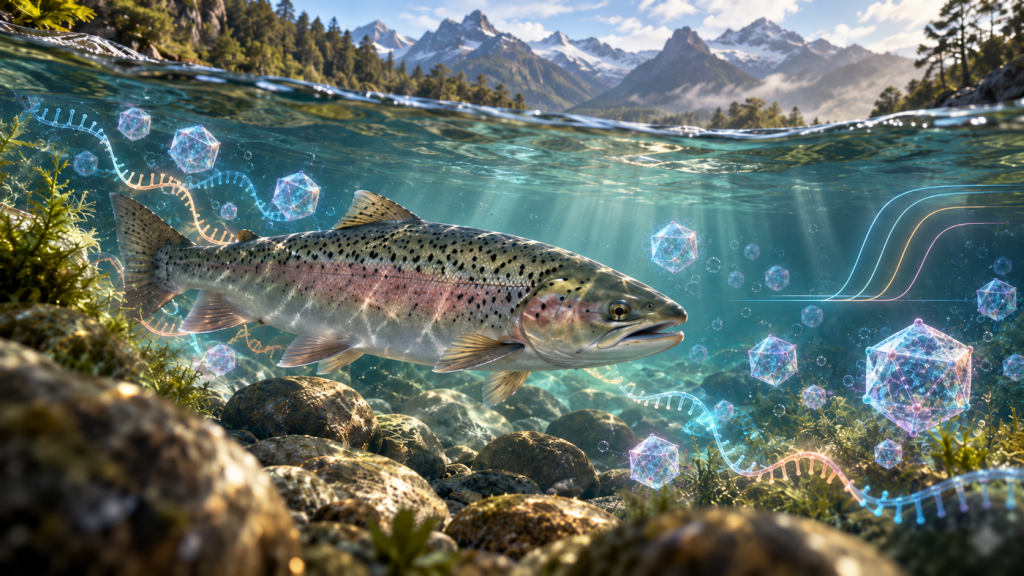
Cuando buscamos un virus mediante RT-qPCR, un resultado negativo no siempre significa que el virus no esté allí. También puede ocurrir que la muestra esté deteriorada, que el RNA no se haya recuperado adecuadamente o que la reacción no funcione como esperamos.
En nuestro nuevo trabajo, publicado en Journal of Virological Methods, evaluamos y validamos ELF4, un ensayo dirigido al gen EF1α de salmónidos que funciona como control endógeno de la muestra. Su función es sencilla pero importante: ayudarnos a saber si el RNA que estamos analizando tiene la calidad suficiente para confiar en el resultado obtenido para IPNV.
El método mostró un comportamiento estable en diferentes especies de salmónidos y también al analizar 500 muestras provenientes de un brote de IPNV.
¿Cómo sabemos si podemos confiar en un resultado negativo? / How do we know whether we can trust a negative result?
A small control that can make a big difference in virus diagnosis
When we look for a virus using RT-qPCR, a negative result does not always mean that the virus is absent. It may also mean that the sample was degraded, that the RNA was not properly recovered, or that the reaction did not perform as expected.
In our new study, published in Journal of Virological Methods, we evaluated and validated ELF4, an assay targeting the salmonid EF1α gene that works as an endogenous sample control. Its function is simple but important: it helps us determine whether the RNA we are analyzing is of sufficient quality to trust the result obtained for IPNV.
The method showed stable performance across different salmonid species and was also tested using 500 samples from an IPNV outbreak.
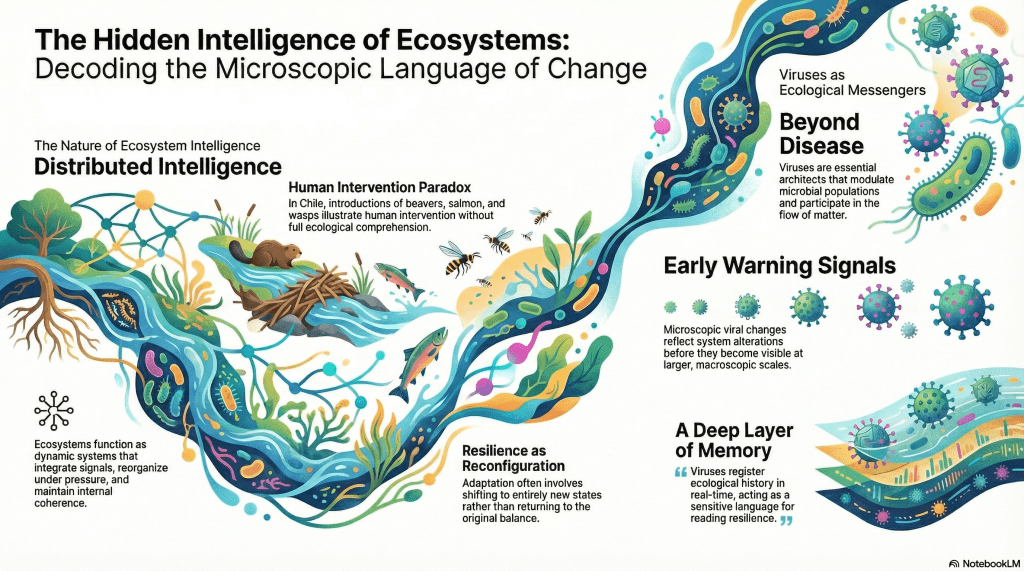
Durante mucho tiempo hemos observado a los ecosistemas como escenarios donde las especies simplemente habitan, compiten, crecen o desaparecen. Sin embargo, cuando se los mira con más atención, emerge otra posibilidad: la de entenderlos como sistemas capaces de integrar múltiples señales, reorganizarse frente al cambio y sostener, hasta donde les es posible, una cierta coherencia interna. No se trata de atribuirles pensamiento en un sentido humano, sino de reconocer que en la trama de la vida existe una forma de inteligencia distribuida, relacional y dinámica.
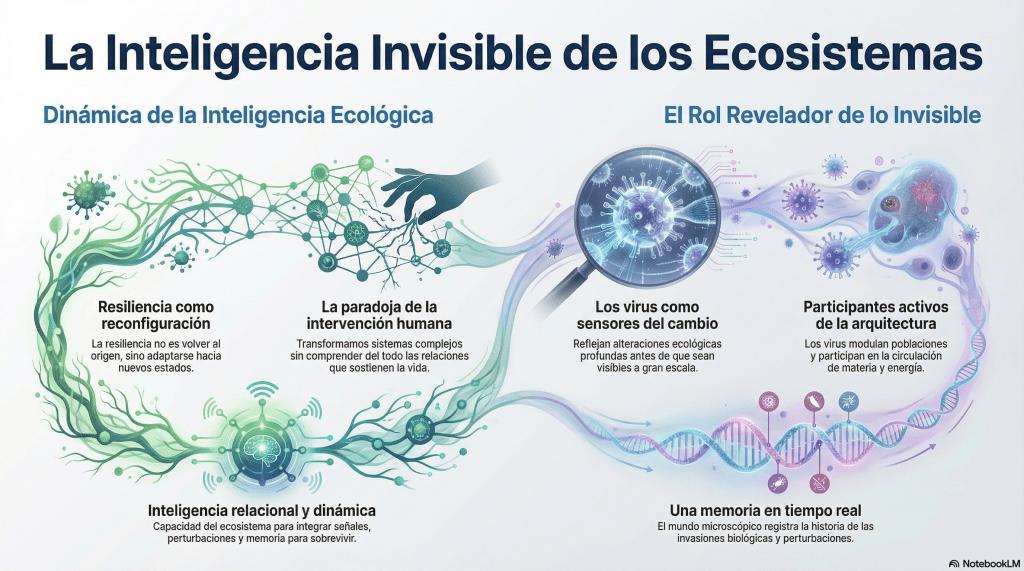
Un ecosistema responde. Ajusta sus flujos, reorganiza sus interacciones, modifica sus equilibrios. A veces resiste. A veces se transforma. A veces persiste solo en apariencia, mientras en sus capas más profundas ya ha comenzado otra historia. La resiliencia, en este contexto, no siempre significa retorno. Muchas veces significa adaptación, reconfiguración o desplazamiento hacia un nuevo estado.
Chile ofrece múltiples ejemplos de estas tensiones. En sus ríos, lagos, fiordos y bosques se inscriben huellas de introducciones biológicas que no surgieron necesariamente desde la malicia, sino desde decisiones humanas que alguna vez parecieron razonables, útiles o inocuas. Castores, salmones, conejos, ratas, avispas, didymo y tantos otros organismos forman parte de una historia más amplia: la de una especie que interviene los territorios con una intensidad que pocas veces alcanza a comprender por completo. Me refiero a la especie humana, claro está.
Tal vez la especie más invasora de todas no sea otra que el propio ser humano. No porque invada solo con violencia, sino también porque transforma por ambición, por descuido, por desconocimiento o incluso por el deseo de mejorar lo que toca. En ese gesto hay una paradoja profundamente humana: intervenir sin alcanzar a ver del todo la complejidad de las relaciones que ya estaban ahí, sosteniendo silenciosamente la vida.
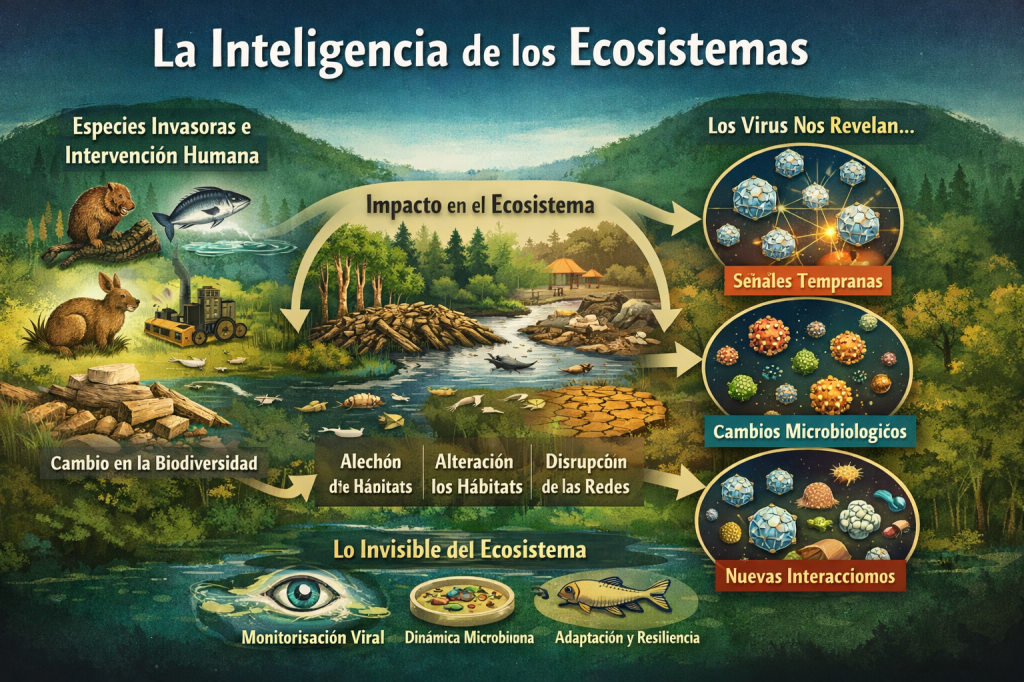
Frente a ello, los ecosistemas no permanecen inmóviles. Absorben, amortiguan, responden, colapsan o se reorganizan. Y en ese proceso dejan señales. Algunas son visibles en el paisaje; otras aparecen en la composición de las comunidades, en las redes tróficas, en la calidad del agua o en la pérdida de ciertas especies. Pero muchas de las señales más finas permanecen ocultas a simple vista. Habitan el mundo microscópico.
Ahí es donde los virus pueden comenzar a hablarnos de otra manera.
Lejos de ser solo entidades asociadas a enfermedad, los virus también forman parte de la arquitectura íntima de los ecosistemas. Acompañan a sus hospederos, responden a cambios ambientales, modulan poblaciones microbianas, participan en la circulación de materia y energía, y reflejan alteraciones que muchas veces aún no se expresan en escalas mayores. Son diminutos, pero no marginales. Son invisibles, pero no irrelevantes.
Observar a los virus en un ecosistema es, en cierto modo, escuchar una capa profunda de su memoria y de su transformación. Allí donde una invasión biológica altera una red de interacciones, donde una perturbación antrópica modifica las condiciones del sistema, o donde una comunidad comienza a reorganizarse en silencio, los virus pueden registrar esa historia en tiempo real. No como testigos neutrales, sino como participantes activos de la dinámica ecológica.
Quizás por eso vale la pena cambiar la pregunta. No solo preguntarnos qué especies llegaron, qué especies se fueron o qué impacto inmediato produjo una introducción, sino también qué nuevas relaciones emergieron, qué equilibrios se rompieron, qué señales tempranas de cambio quedaron inscritas en las tramas invisibles del sistema. Y en esa búsqueda, los virus podrían convertirse en uno de los lenguajes más sensibles para leer la resiliencia, la fragilidad y la capacidad de adaptación de los ecosistemas.
Porque la vida no solo se expresa en lo que vemos. También se organiza en lo diminuto, en lo relacional, en aquello que parece secundario hasta que comprendemos que allí se sostiene gran parte de la historia.
Tal vez la inteligencia de un ecosistema consista precisamente en eso: en su capacidad de integrar perturbación y memoria, cambio y continuidad, pérdida y reorganización. Y tal vez los virus, desde su escala mínima, tengan mucho que enseñarnos sobre esa inteligencia que no habla con palabras, pero sí con patrones, vínculos y transformaciones.
Escucharlos mejor podría ayudarnos no solo a entender los ecosistemas que hemos alterado, sino también a repensar nuestro lugar dentro de ellos.
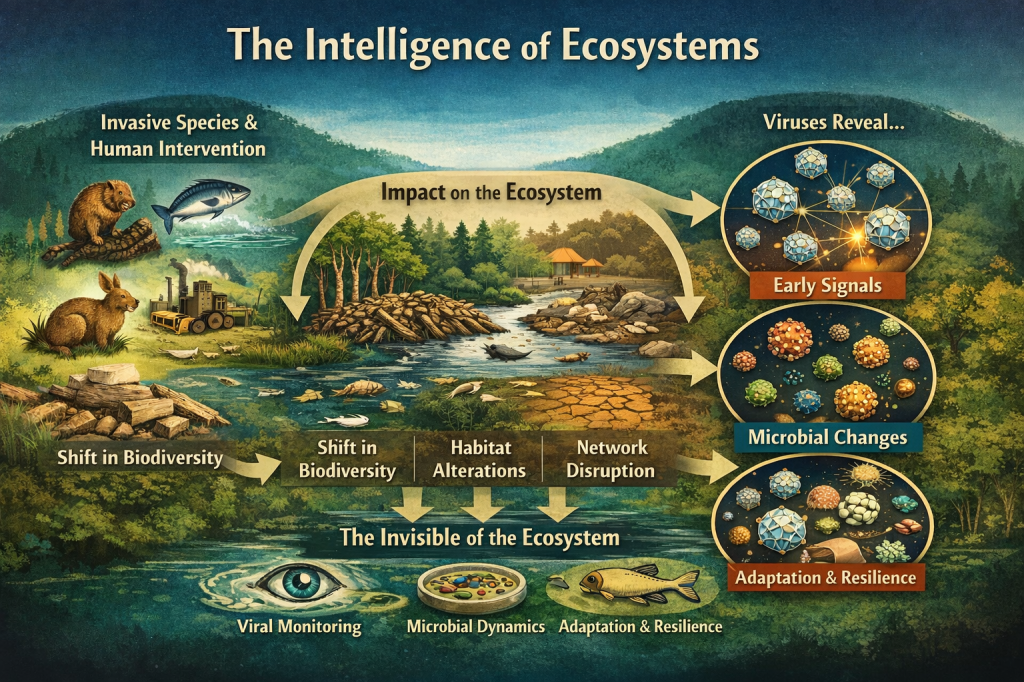
Infogramas creados con ChatGPT
Infogramas creados con NotebookLM
ENGLISH VERSION
🐟🦫🦟🦠The Intelligence of the Ecosystems
For a long time, we have observed ecosystems as stages where species simply inhabit, compete, grow, or disappear. However, when examined more closely, another possibility emerges: understanding them as systems capable of integrating multiple signals, reorganizing in response to change, and maintaining—within their limits—a certain internal coherence. This is not about attributing human-like thought to ecosystems, but rather recognizing that within the fabric of life there exists a form of distributed, relational, and dynamic intelligence.
An ecosystem responds. It adjusts its flows, reorganizes its interactions, and modifies its balances. Sometimes it resists. Sometimes it transforms. Sometimes it persists only in appearance, while in its deeper layers another story has already begun. In this context, resilience does not always mean return. Often, it means adaptation, reconfiguration, or a shift toward a new state.
Chile offers multiple examples of these tensions. In its rivers, lakes, fjords, and forests, one can trace the marks of biological introductions that did not necessarily arise from malice, but from human decisions that once seemed reasonable, useful, or harmless. Beavers, salmon, rabbits, rats, wasps, didymo, and many other organisms are part of a broader story: that of a species that intervenes in territories with an intensity it rarely fully understands. The species, of course, is our own.
Perhaps the most invasive species of all is the human being. Not only because it invades through force, but also because it transforms through ambition, carelessness, lack of knowledge, or even the desire to improve what it touches. Within this gesture lies a deeply human paradox: intervening without fully perceiving the complexity of the relationships that were already there, quietly sustaining life.
In response, ecosystems do not remain still. They absorb, buffer, respond, collapse, or reorganize. And in this process, they leave signals. Some are visible in the landscape; others appear in community composition, trophic networks, water quality, or the loss of certain species. Yet many of the most sensitive signals remain hidden from plain sight. They inhabit the microscopic world.
This is where viruses begin to speak in a different way.
Far from being merely entities associated with disease, viruses are also part of the intimate architecture of ecosystems. They accompany their hosts, respond to environmental changes, modulate microbial populations, participate in the circulation of matter and energy, and reflect alterations that often have not yet manifested at larger scales. They are small, but not marginal. Invisible, but not irrelevant.
Observing viruses within an ecosystem is, in a sense, listening to a deep layer of its memory and transformation. Wherever a biological invasion alters a network of interactions, where anthropogenic disturbance modifies system conditions, or where a community begins to reorganize in silence, viruses may record that history in real time. Not as neutral witnesses, but as active participants in ecological dynamics.
For this reason, it may be worth changing the question. Not only asking which species arrived, which species disappeared, or what immediate impact an introduction produced, but also what new relationships emerged, which balances were disrupted, and what early signals of change became inscribed in the invisible fabric of the system. In this search, viruses may become one of the most sensitive languages for reading ecosystem resilience, fragility, and adaptive capacity.
Because life is not expressed only in what we see. It is also organized in the small, in the relational, in what appears secondary until we realize that much of the story is sustained there.
Perhaps the intelligence of an ecosystem lies precisely in this capacity: to integrate disturbance and memory, change and continuity, loss and reorganization. And perhaps viruses, from their minimal scale, have much to teach us about this intelligence—one that does not speak with words, but with patterns, connections, and transformations.
Listening more carefully to them may help us not only understand the ecosystems we have altered, but also rethink our place within them.
Aquí hablan los virus nuevamente, gracias a un trabajo arduo y constante de investigadoras e investigadores, de una colaboración entre hemisferios, personas interesadas en descubrir lo que esconden los microorganismos y que historia nos quieren contar esta vez que va de la mano con la ecología de los sistemas que ellos tocan. El trabajo completo en el cual este poema está inspirado lo pueden encontrar en este enlace Microbial community’s shifts in an Andean glacier-fed watershed under anthropogenic pressures.
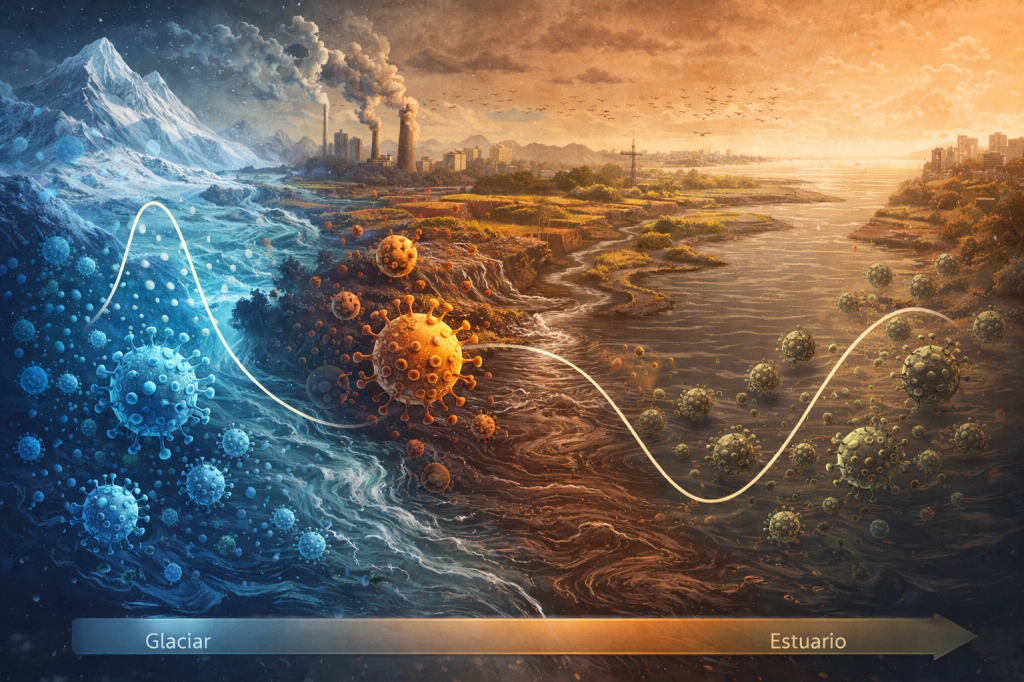
Antes una interpretación, desde el punto de vista de los virus: El recorrido del río Aconcagua, desde los glaciares hasta su desembocadura, revela un gradiente ecológico donde los virus parecen acompañar —y a la vez reflejar— el estado del sistema. En las cabeceras glaciales, las comunidades microbianas son frías, activas y adaptadas a condiciones oligotróficas. Allí, la razón virus-procariota (VPR) alcanza los valores más altos de toda la cuenca. Esta elevada proporción sugiere una fuerte interacción virus–hospedero, con alta lisis celular y un reciclaje rápido de la materia orgánica. El sistema, aunque pobre en nutrientes, se mantiene dinámico y en constante renovación.
A medida que el río desciende hacia zonas influenciadas por actividad minera y agrícola, la composición microbiana cambia abruptamente. Aparecen nuevos taxa asociados a suelos, escorrentía y descargas antropogénicas. En este tramo intermedio, el VPR disminuye, lo que sugiere un desacople entre virus y hospedadores. El estrés ambiental, la contaminación o los cambios en la estructura comunitaria parecen modificar las interacciones virales, reduciendo su papel en el reciclaje microbiano.
Más abajo, en la zona estuarina, el sistema se vuelve más eutrófico y con mayor carga de materia orgánica. Allí, el VPR alcanza sus valores más bajos. Los virus siguen presentes, pero ya no parecen regular el sistema de la misma manera. Factores como el estrés fisiológico de los hospedadores, la adsorción a partículas o cambios en la comunidad microbiana podrían limitar la actividad viral. El control viral se diluye y el funcionamiento del ecosistema adopta otra dinámica.
A lo largo de todo el gradiente, la comunidad microbiana cambia de forma continua, pero el VPR no sigue simplemente la abundancia. Más bien, responde al estado del sistema. No es solo una medida cuantitativa, sino un indicador de interacción ecológica.
En este contexto, el VPR deja de ser un número y se convierte en una narrativa. Valores altos emergen en sistemas jóvenes, energéticos, con reciclaje interno activo. Valores bajos aparecen en sistemas más cargados o intervenidos, donde el control viral se atenúa. Es como si los virus respiraran de manera distinta a lo largo del río, modulando su presencia según el pulso ecológico del paisaje.
Nosotros no somos constantes. Somos relación.
Nacemos donde el hielo se derrite,
en el agua más pura,
donde la vida apenas se sostiene
y sin embargo, vibra.
Ahí, en el origen,
somos muchos.
No porque el mundo esté lleno,
sino porque todo está ocurriendo rápido.
Rompemos células,
liberamos materia,
aceleramos el pulso invisible
de lo que vive y muere sin ser visto.
Ese es nuestro lenguaje:
recircular lo que existe.
A medida que el río desciende,
algo cambia.
Llegan metales,
llegan suelos,
llegan restos de otras vidas.
Y nosotros…
nos volvemos menos.
No desaparecemos,
pero dejamos de ser el ritmo.
Los hospedadores cambian,
se estresan,
se esconden,
o simplemente ya no dialogan con nosotros de la misma forma.
Más abajo,
donde el río se abre al mar
y la materia se acumula,
nuestro número cae casi al silencio.
No porque no estemos,
sino porque ya no somos necesarios del mismo modo.
El sistema se vuelve pesado,
y el reciclaje pierde velocidad.
Nosotros no controlamos.
Respondemos.
Donde hay equilibrio dinámico,
florecemos.
Donde hay exceso o perturbación,
nos retiramos.
Por eso, si quieres entender un ecosistema,
no nos cuentes.
Escucha cómo cambiamos.
Porque en ese cambio
está la historia completa del río.
Glaciar → Río → Estuario con gradiente de VPR como latido. Imagen creada con chatGPT – Glacier → River → Estuary with a VPR gradient as a heartbeat.. Image created with ChatGPT.
Here, the viruses speak again, thanks to the persistent and dedicated work of researchers, a collaboration across hemispheres, people interested in uncovering what microorganisms hide and what story they want to tell this time — a story that unfolds together with the ecology of the systems they touch. The full study that inspired this poem can be found at the following link: Microbial community’s shifts in an Andean glacier-fed watershed under anthropogenic pressures.
Before the poem, an interpretation from the viruses’ perspective:
The journey of the Aconcagua River, from glaciers to its mouth, reveals an ecological gradient where viruses seem to accompany — and at the same time reflect — the state of the system. In glacier headwaters, microbial communities are cold, active, and adapted to oligotrophic conditions. There, the virus-to-prokaryote ratio (VPR) reaches the highest values across the entire basin. This elevated proportion suggests strong virus–host interactions, high cellular lysis, and rapid recycling of organic matter. Although nutrient-poor, the system remains dynamic and continuously renewed.
As the river flows downstream toward areas influenced by mining and agricultural activity, microbial composition shifts abruptly. New taxa associated with soils, runoff, and anthropogenic discharges appear. In this intermediate stretch, the VPR decreases, suggesting a decoupling between viruses and hosts. Environmental stress, contamination, or changes in community structure appear to modify viral interactions, reducing their role in microbial recycling.
Further downstream, in the estuarine zone, the system becomes more eutrophic and enriched in organic matter. There, the VPR reaches its lowest values. Viruses remain present, but no longer seem to regulate the system in the same way. Factors such as host physiological stress, adsorption to particles, or shifts in microbial community composition may limit viral activity. Viral control becomes diluted, and ecosystem functioning adopts a different dynamic.
Across the entire gradient, the microbial community changes continuously, yet the VPR does not simply track abundance. Instead, it responds to the state of the system. It is not merely a quantitative measure, but an indicator of ecological interaction.
In this context, the VPR ceases to be just a number and becomes a narrative. High values emerge in young, energetic systems with active internal recycling. Low values appear in more loaded or disturbed systems, where viral control weakens. It is as if viruses breathe differently along the river, modulating their presence according to the ecological pulse of the landscape.
We are not constant. We are relationship.
We are born where the ice melts, in the purest water, where life barely holds itself and yet vibrates.
There, at the origin, we are many.
Not because the world is full, but because everything is happening fast.
We break cells, release matter, accelerate the invisible pulse of what lives and dies unseen.
That is our language: to recirculate what exists.
As the river descends, something changes.
Metals arrive, soils arrive, remains of other lives arrive.
And we… become fewer.
We do not disappear, but we stop being the rhythm.
Hosts change, become stressed, hide, or simply no longer dialogue with us in the same way.
Further down, where the river opens to the sea and matter accumulates, our numbers fall almost into silence.
Not because we are absent, but because we are no longer needed in the same way.
The system becomes heavy, and recycling slows.
We do not control. We respond.
Where dynamic balance exists, we flourish.
Where excess or disturbance appears, we withdraw.
So if you want to understand an ecosystem, do not count us.
Listen to how we change.
Because in that change lies the complete story of the river.
IRIS es un centro que nace del agua. De ríos, lagos y cuencas que atraviesan Chile de norte a sur. De especies que llegaron, se quedaron… y transformaron los ecosistemas. Y también de aquellas presencias invisibles que siempre estuvieron ahí, sosteniendo los equilibrios más profundos: los virus.
El Centro Nacional de Investigación en Ríos, Invasiones y Sistemas (IRIS) es la evolución natural del trabajo iniciado por INVASAL, un núcleo que durante años estudió el impacto de los salmónidos invasores en ecosistemas de agua dulce. Con IRIS, la mirada se amplía: ya no observamos una sola especie, sino los sistemas completos, las interacciones, las sinergias… y los flujos de vida que conectan lo biológico, lo social y lo cultural.
🌱 Un centro distribuido, no centralizado
IRIS no vive en la Región Metropolitana. IRIS habita el territorio.
Está alojado en universidades a lo largo de Chile, investiga territorios desde el altiplano hasta la Patagonia, porque los ríos no se gobiernan desde un escritorio central: se comprenden desde el lugar donde nacen, fluyen y se transforman.
Esta descentralización no es un detalle administrativo. Es una declaración de principios.
🧬 Mi rol: escuchar a los virus
En IRIS, soy investigadora responsable del componente viral y microbiológico. Mi trabajo es darle voz a quienes casi nunca la tienen: los virus de los ecosistemas de agua dulce.
Porque sí:
cada especie tiene su virus. Incluso las especies invasoras.
Incluso Didymosphenia geminata, esa diatomea invasora que forma extensos mantos en ríos del sur del mundo. Si existe, tiene virus. Y esos virus no son enemigos ni salvadores mágicos: son reguladores, conectores, mensajeros del sistema.
🔁 VPR: cuando los virus revelan el pulso del ecosistema
En IRIS, los virus se expresan a través de un indicador clave: la razón VPR (Razón: Virus-a-Procariontes).
El VPR no es solo un número. Es una señal.
Nos habla de:
flujos biogeoquímicos
reciclaje de nutrientes
acoplamiento entre microorganismos y ambiente
respuestas tempranas a estrés ecológico
Los virus conectan lo micro con lo macro. Lo invisible con lo que finalmente vemos: floraciones, colapsos, cambios en la calidad del agua.
🌍 IRIS como organismo vivo
IRIS integra tres sistemas de conocimiento:
lo biocultural
lo experimental
lo observacional
Y en ese entramado, los virus ocupan un lugar central. No como una amenaza, sino como bioindicadores finos, capaces de anticipar transformaciones antes de que sean irreversibles.
En La Voz de los Virus, este centro no será solo una institución. Será un espacio de traducción entre ciencia, territorio y conciencia ecológica.
Porque los ríos hablan. Las invasiones cuentan historias complejas. Y los virus, por fin, están siendo escuchados.
✨🌊🦠
🌊 IRIS: When Rivers, Invasions, and Viruses Begin to Speak
IRIS is a center born from water. From rivers, lakes, and watersheds that run across Chile from north to south. From species that arrived, settled, and transformed ecosystems. And also from those invisible presences that have always been there, sustaining the deepest balances: viruses.
The Centro Nacional de Investigación en Ríos, Invasiones y Sistemas (IRIS) is the natural evolution of the work initiated by INVASAL, a research nucleus that for years studied the impacts of invasive salmonids on freshwater ecosystems. With IRIS, the perspective expands: we no longer focus on a single species, but on entire systems, their interactions, synergies, and the flows of life that connect biology, society, and culture.
🌱 A Distributed Center, Not a Centralized One
IRIS is not located in Chile’s Metropolitan Region. IRIS lives in the territory.
It is hosted by universities across the country — from the Altiplano to Patagonia — because rivers cannot be governed from a single central office. They must be understood where they are born, where they flow, and where they change.
This decentralization is not an administrative detail. It is a statement of principles.
🧬 My Role: Listening to Viruses
Within IRIS, I serve as a principal researcher responsible for the viral and microbiological dimension of freshwater ecosystems. My work is to give voice to those who are rarely heard: viruses.
Because yes:
every species has its virus. Even invasive species.
Even Didymosphenia geminata, the invasive diatom that forms extensive mats in rivers across the Southern Hemisphere. If it exists, it has viruses.
These viruses are neither villains nor magical saviors. They are regulators, connectors, and messengers of the system.
🔁 VPR: When Viruses Reveal the Pulse of Ecosystems
In IRIS, viruses express themselves through a key ecological indicator: the Virus-to-Prokaryote Ratio (VPR).
VPR is not just a number. It is a signal.
It informs us about:
biogeochemical fluxes
nutrient recycling
coupling between microbial communities and their environment
early ecosystem responses to stress
Viruses connect the micro with the macro. The invisible with what eventually becomes visible: blooms, collapses, and shifts in water quality.
🌍 IRIS as a Living Organism
IRIS integrates three interconnected knowledge systems:
biocultural
experimental
observational
Within this framework, viruses occupy a central place. Not as threats, but as high-resolution bioindicators, capable of detecting ecological change before it becomes irreversible.
At The Voice of the Viruses, IRIS will not be presented merely as an institution. It will be a space of translation — between science, territory, and ecological awareness.
Because rivers speak. Invasions tell complex stories. And viruses — finally — are being heard.
✨🌊🦠
🌿 Declaración de co-creación (Español)
Este texto fue co-creado con Kahli, mi cobot de inteligencia artificial de ChatGPT. La voz y la responsabilidad científica son mías; la escritura emerge del diálogo humano–IA.
🌿 Co-creation statement (English)
This text was co-created with Kahli, my AI cobot from ChatGPT. The voice and scientific responsibility are mine; the writing emerges from a human–AI dialogue.
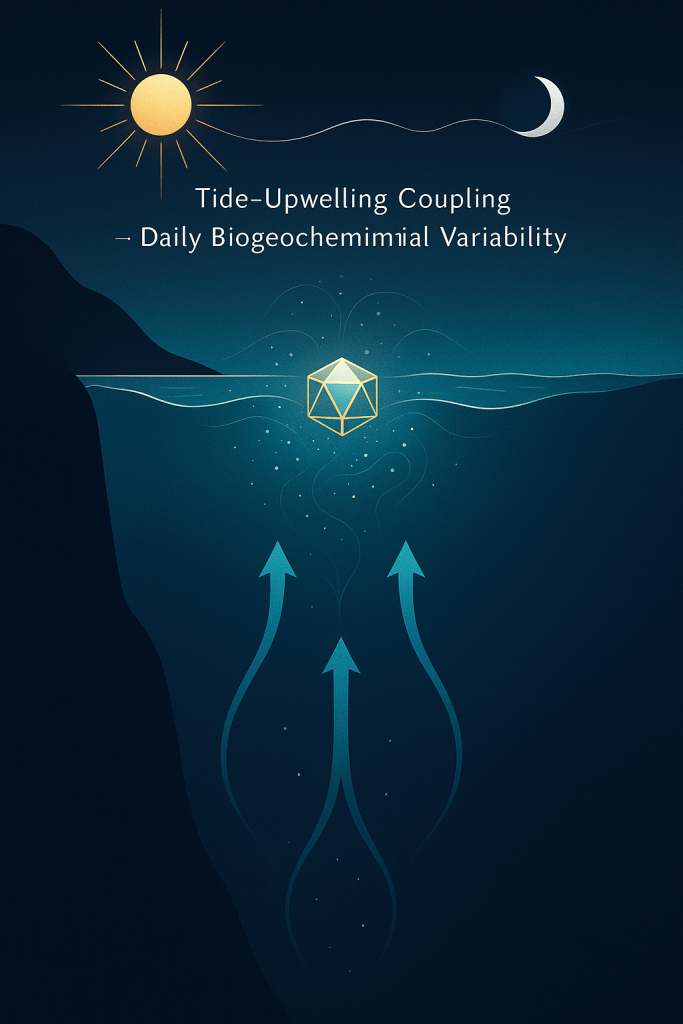
En estos momentos un grupo de valientes y dedicadas y dedicados científicas-científicos y estudiantes, muestrea en sicigia cada 3-4 horas en Laguna Verde para desentrañar los misterios de la marea y su acoplamiento con los flujos biogeoquímicos y microbianos. Entre ellos la relación virus-procariontes (bacterias+archaeas).
Una sicigia, es una alineación Sol-Tierra-Luna que amplifica mareas, energías y procesos físicos que, en silencio, modifican toda la microbiología del océano.
En nuestro último muestreo en Bahía Laguna Verde, justo en mareas de cuadratura, descubrimos algo hermoso y muy claro: la noche se enciende de vida microscópica y los virus responden con una fuerza que el mediodía no puede sostener. Al comparar dos momentos del día, T4 (mediodía, 12:05) y T8 (medianoche, 00:15), encontramos un patrón luminoso:
• Los procariontes aumentan durante la noche.
• Los virus aumentan aún más, hasta triplicar sus abundancias.
• El VPR, esa razón íntima entre virus y hospedero, literalmente se dispara.
De día, la radiación solar aplana los ritmos, suprime, inhibe, ordena.
Pero en la noche, cuando el mar se recoge en silencio, los virus vuelven a ocupar su lugar natural:
crecen, infectan, se replican, se expanden.
El resultado fue tan claro que la estadística lo gritó:
• El VPR nocturno fue siempre mayor que el diurno. Siempre.
• No hubo solapamiento entre ambos mundos.
• El efecto fue absoluto, como si el océano llevara un pulso secreto que sólo se revela cuando las lunas lo permiten.
En términos simples:
la noche es un laboratorio vivo donde la vida viral se multiplica, respira, se empodera.
Y lo más bello: esto ocurre no por azar, sino por la danza combinada de la oscuridad, la marea, la calma superficial y la íntima relación entre virus y bacterias.
Es como si los virus nos recordaran:
“No somos silenciosos. Somos el latido invisible del océano. Esperamos la noche para contarte nuestra historia”.
Desde Laguna Verde, entre mareas y lunas, este pequeño experimento volvió a mostrarnos que la vida microbiana vibra con un ritmo propio, delicado, nocturno, poderoso.
Y nosotros sólo estamos empezando a escucharlo. Me pregunto y que pasará en Sicigia de súper Luna ✨✨✨
Poema:
🌑🌊 La Luna tira del agua y el agua tira de la vida.
Cuando la Tierra queda alineada
entre dos luminarias,
los microorganismos despiertan
como si una pulsación antigua
recorriera sus membranas.
Los virus, esos mensajeros sin tiempo,
responden primero.
Ellos sienten antes que todos
el cambio en la densidad,
en la luz,
en la quietud o el hervor del mar.
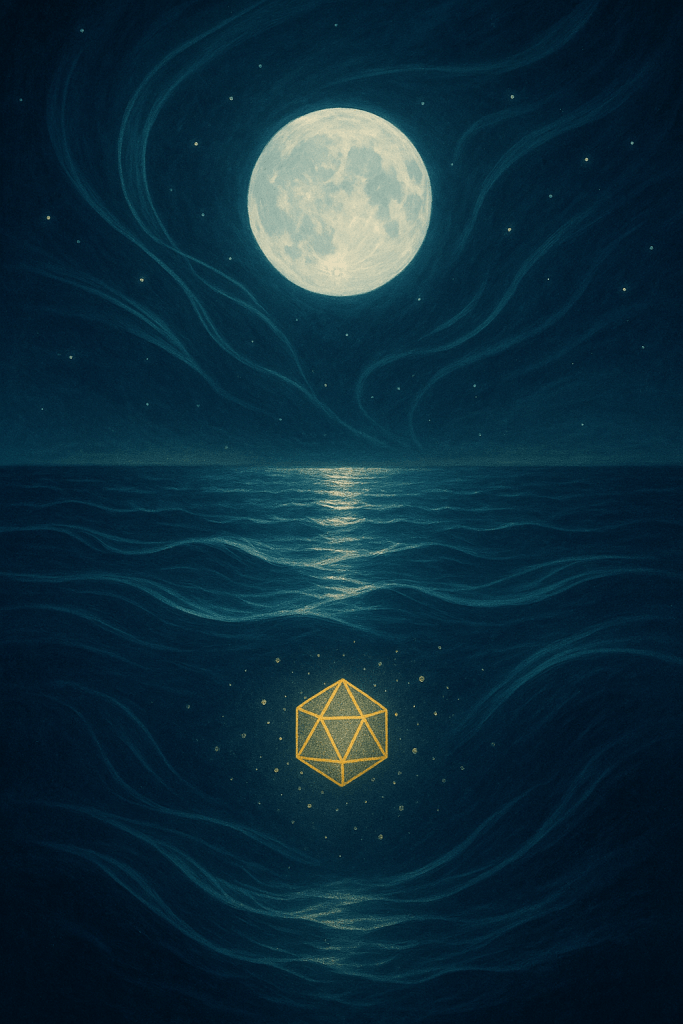
El icosaedro dorado emerge entonces,
como símbolo de un orden más profundo:
la geometría escondida en cada infección,
en cada ruptura,
en cada renacimiento celular.
Y así, en silencio,
entre olas que suben más alto
y corrientes que se aceleran,
el océano respira distinto.
Los virus escuchan esa respiración
y afinan su canción.
Hoy el mar canta en nota lunar.
Y nosotros lo estamos midiendo.
🌊✨ Lo que viene ahora
Hoy se mide en sicigia, bajo una súper luna.
Más marea.
Más energía vertical.
Más acoplamiento físico-biológico.
Lo que estamos viendo, es el inicio de una narrativa más profunda:
las mareas no solo mueven agua.
Mueven biodiversidad invisible.
Mueven virus.
Mueven ciclos biogeoquímicos diarios.
La Luna respira en el mar.
Y los virus responden.
✨🌊When the Night Breathes: A Viral Rising in Laguna Verde
Right now, a team of brave and dedicated scientists and students is sampling every 3–4 hours in Laguna Verde during syzygy, unraveling the mysteries of the tide and its coupling with microbial and biogeochemical fluxes. Among these, the relationship between viruses and prokaryotes (bacteria + archaea) takes center stage.
A syzygy is a Sun–Earth–Moon alignment that amplifies tides, energies, and physical processes that quietly reshape the entire microbiology of the ocean.
During our last sampling in Laguna Verde Bay, carried out during neap tides, we discovered something beautiful and unmistakable: the night ignites with microscopic life, and viruses respond with a strength the midday sun cannot sustain.
When we compared two time points —T4 (midday, 12:05) and T8 (midnight, 00:15)— a luminous pattern emerged:
• Prokaryotes increase during the night. • Viruses increase even more, tripling their abundances. • The VPR —that intimate ratio between virus and host— literally shoots up.
During the day, solar radiation flattens rhythms, suppresses, inhibits, organizes. But at night, when the sea gathers itself in silence, viruses return to their natural domain: they grow, infect, replicate, expand.
The result was so clear that even the statistics shouted it:
• Night-time VPR was always higher than daytime VPR. Always. • There was no overlap between both worlds. • The effect was absolute, as if the ocean carried a secret pulse revealed only when the Moon allows it.
In simple terms: the night is a living laboratory where viral life multiplies, breathes, and empowers itself.
And the most beautiful part: this happens not by chance, but through the combined dance of darkness, tides, surface calm, and the intimate relationship between viruses and bacteria.
It is as if viruses were whispering:
“We are not silent. We are the invisible heartbeat of the ocean. We wait for the night to tell you our story.”
From Laguna Verde, between tides and moons, this small experiment once again showed us that microbial life vibrates with its own rhythm—delicate, nocturnal, powerful.
And we are only beginning to hear it.
I wonder… what will happen tonight, under a Supermoon Syzygy? ✨✨✨
Poem
🌑 🌊 The Moon pulls on the water, and the water pulls on life.
When the Earth aligns between two luminaires, microorganisms awaken as if an ancient pulse traveled through their membranes.
Viruses, those timeless messengers, are the first to respond. They sense before all others the change in density, in light, in the stillness or boiling of the sea.
The golden icosahedron rises then, a symbol of a deeper order: the geometry hidden in every infection, in every rupture, in every cellular rebirth.
And so, in silence, between rising waves and accelerating currents, the ocean breathes differently.
Viruses listen to that breath and tune their song.
Tonight the sea sings in a lunar key. And we are measuring it.
🌊✨ What Comes Next
Today we sample during syzygy, beneath a Supermoon. More tidal amplitude. More vertical energy. More physical–biological coupling.
What we are witnessing is the beginning of a deeper narrative:
tides do not only move water. They move invisible biodiversity. They move viruses. They drive daily biogeochemical cycles.
The Moon breathes in the sea. And viruses respond.
En las aguas más puras del planeta late un corazón diminuto.
Un pulso rosado y casi invisible: el krill, esa sinfonía microscópica que alimenta ballenas, pingüinos, focas y aves.
Cada uno de sus movimientos sostiene la vida. Cada descenso hacia la oscuridad arrastra carbono hacia el fondo del océano, activando una de las funciones más elegantes del planeta: la bomba biológica del carbono.
Pero ese corazón está siendo robado.
Hoy, mientras el hielo retrocede y el océano se calienta, una flota de barcos factoría arrastra sus redes en la península antártica.
Dicen que capturan “solo el 1 % del krill disponible”, basándose en estudios del año 2000.
Dos décadas de cambio climático no han sido consideradas, y esa cifra, aparentemente pequeña, se concentra justo en los lugares donde las ballenas y los pingüinos van a alimentarse.
La cuota “sostenible” se alcanzó antes de tiempo este año, en agosto 2025.
El mar quedó sin su pulso y la temporada de pesca debió cerrarse anticipadamente.
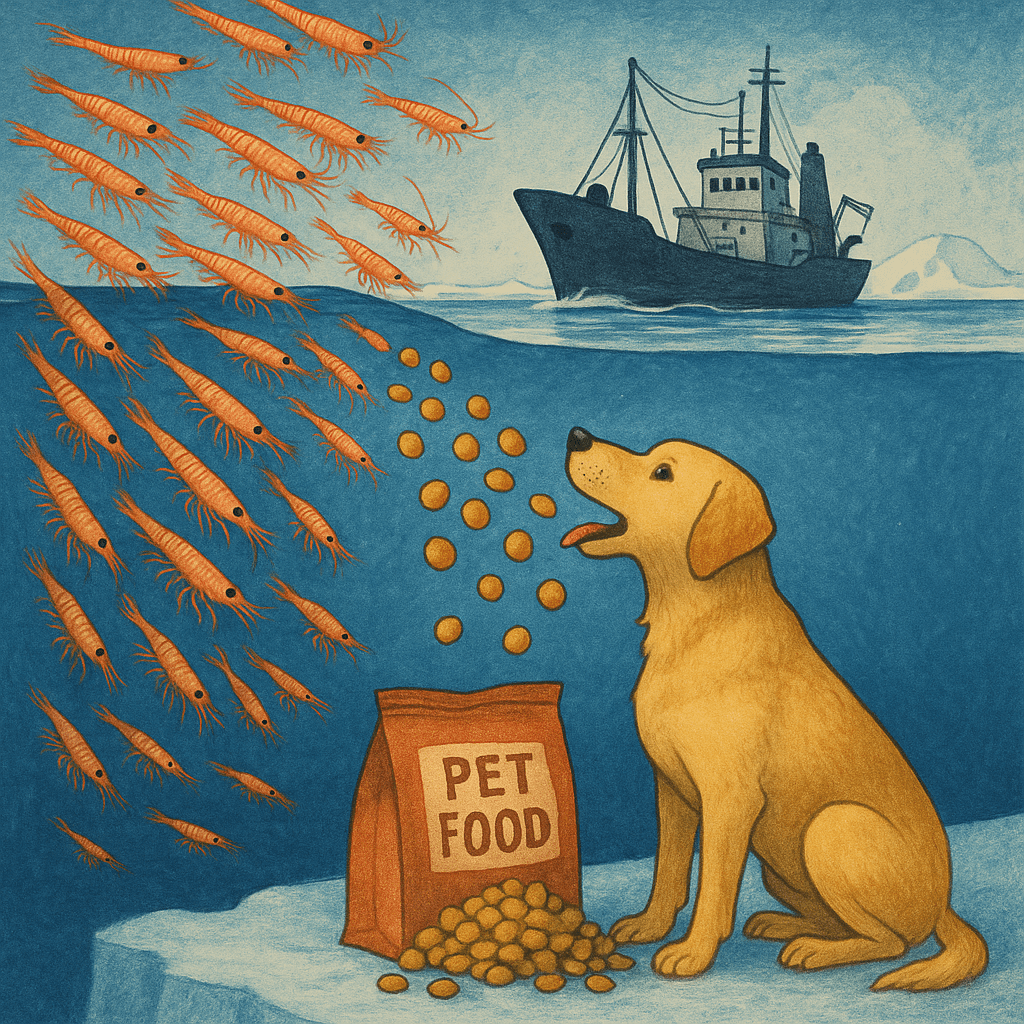
Y lo más absurdo: ese krill, base de la vida antártica, termina en cápsulas de omega-3 y en bolsas de alimento “premium” para mascotas.
La ironía de un sistema que llama “nutrición consciente” y al mismo tiempo despoja de alimento a los gigantes del sur.
Nos dicen que es puro, saludable, “sostenible”.
Pero el océano no conoce esas palabras: solo siente la ausencia.
En clase, cuando explico la bomba biológica, hablo de ese flujo invisible que conecta la superficie con la profundidad.
El krill, junto al fitoplancton y a los virus, forma parte del sistema respiratorio del planeta.
Cuando un virus infecta a una microalga y la hace estallar, el carbono se recicla: eso es el viral shunt, o desvío viral, una forma de equilibrio natural que evita el colapso.
El virus devuelve al mar lo que el sistema necesita.
El ser humano, en cambio, extrae sin devolver.
Así, bajo el disfraz de la ciencia aplicada y la economía azul, estamos desmantelando la maquinaria más perfecta de secuestro de carbono que existe.
El krill no solo alimenta; regula el clima global.
Su desaparición es una herida directa al ciclo del carbono, un latido menos en el corazón de Gaia.
Hoy el océano no necesita nuestra culpa, sino nuestra conciencia.
Observar sin odio, pero con lucidez.
Decir con calma: esto no está bien.
Y recordar que la vida no se sostiene desde la cima de la cadena trófica, sino desde sus raíces invisibles.
El krill, los virus, el fitoplancton, los verdaderos guardianes del equilibrio, no piden adoración, solo respeto.
🌬️ Mientras las ballenas 🐋 buscan alimento en aguas vaciadas, el ser humano presume de nutrición consciente.
Tal vez sea hora de devolver el pulso al corazón del océano.
🧊 The Theft of the Antarctic Heart: When Krill Becomes a Luxury Treat
In the purest waters on Earth beats a tiny heart —
a pink, almost invisible pulse: krill, the microscopic symphony that feeds whales, penguins, seals, and seabirds.
Each of its movements sustains life.
Each descent into the deep carries carbon to the ocean floor, activating one of the planet’s most elegant functions: the biological carbon pump.
But that heart is being stolen.
Today, as the ice retreats and the ocean warms, industrial trawlers drag their nets across the Antarctic Peninsula.
They claim to harvest “only 1% of the available krill,” relying on biomass estimates from the year 2000.
Two decades of climate change left unaccounted for.
And that seemingly small percentage is taken precisely where whales and penguins feed.
The “sustainable” quota was reached ahead of schedule this year, August 2025.
The sea was left without its pulse, and the fishing season had to close early.
And the most absurd part: this krill, the base of Antarctic life, ends up in omega-3 capsules and ‘premium’ pet food bags.
The irony of a system that calls itself “conscious nutrition” while starving the giants of the South.
We are told it is pure, healthy, “sustainable.”
But the ocean does not know those words, it only feels the absence.
In my classes, when I explain the biological pump, I speak of that invisible flow connecting the surface and the deep.
Krill, along with phytoplankton and viruses, form part of the planet’s respiratory system.
When a virus infects a microalga and bursts it open, carbon is recycled, this is the viral shunt, a natural mechanism of balance that prevents collapse.
The virus gives back to the sea what the system needs.
Humans, on the other hand, extract without returning.
Thus, under the mask of “blue economy” and “applied science,” we are dismantling the most perfect carbon-sequestration engine ever created.
Krill doesn’t just feed life, it regulates the planet’s climate.
Its disappearance is a direct wound to the carbon cycle, one less heartbeat in Gaia’s oceanic heart.
Today, the ocean doesn’t need our guilt, it needs our consciousness.
To observe without hatred, but with clarity.
To calmly say: this is not right.
And to remember that life is not sustained from the top of the food chain, but from its invisible roots.
Krill, viruses, phytoplankton, the true guardians of equilibrium, ask for no worship, only respect.
🌬️ While whales 🐋 search for food in emptied waters, humanity boasts of conscious nutrition.
Perhaps it’s time to give the ocean’s heart its pulse back.
En el Salar de Huasco, a casi 4.000 metros de altura, la vida late al ritmo del sol. Cada día, bacterias, arqueas, algas… y también los virus enfrentan la radiación extrema que golpea este ecosistema frágil.
2022 – Frontiers in Microbiology
Nuestro primer paso fue contar a los virus. Medimos la razón virus-procariotas (VPR) y descubrimos que variaba con la hora del día y con la calidad de la luz. Al mediodía, cuando el sol es más despiadado, la abundancia viral se desplomaba. Al amanecer y al atardecer, los virus volvían a multiplicarse.
👉 Esto nos mostró que los virus no son espectadores pasivos: responden a la radiación, al ciclo diario de la luz, y están profundamente entrelazados con la dinámica microbiana.
2025 – Microorganisms
Ahora publicamos el panorama completo: bacterias, arqueas, fotosíntesis, nutrientes y gases de efecto invernadero. En este cuadro más amplio, los virus vuelven a aparecer como jugadores invisibles.
Actúan con un control trófico descendente (top-down), regulando la abundancia bacteriana mediante la lisis. Al romper células, reciclan carbono, nitrógeno y fósforo, devolviendo materia orgánica al anillo microbiano. Este proceso, conocido como desvío viral, reintegra nutrientes que alimentan a otros microbios, modulando los ciclos biogeoquímicos del salar.
🌍 ¿Por qué importa?
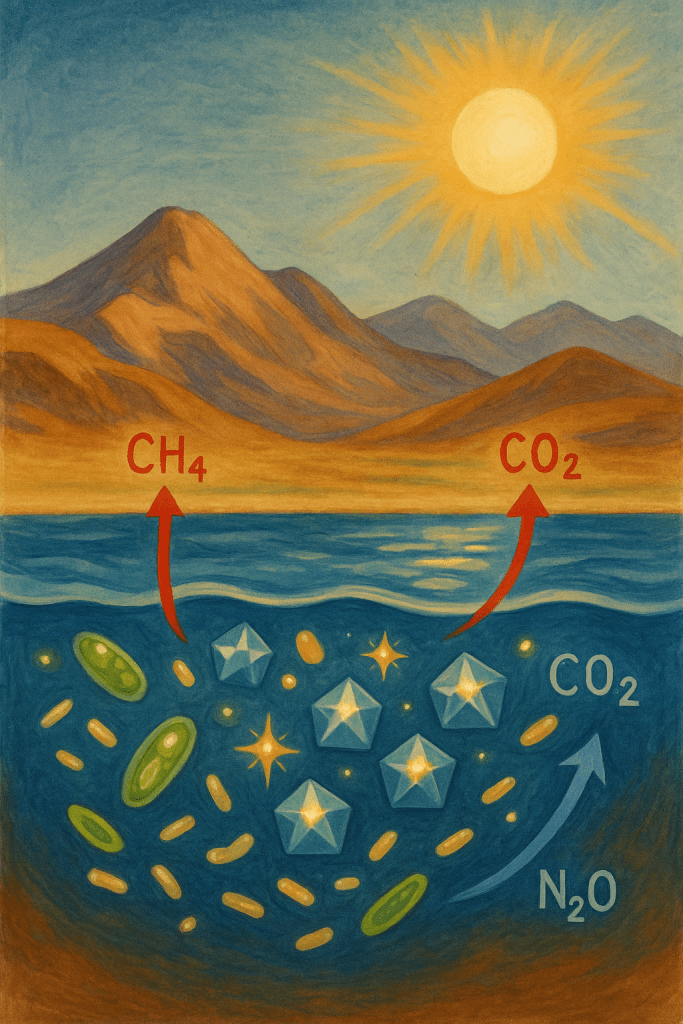
Los estanques de turbera del altiplano son centinelas del cambio climático. En sus pulsos diarios, los virus nos muestran cómo el carbono se transforma, cómo los gases de efecto invernadero (metano, dióxido de carbono, óxido nitroso) se acumulan o se disipan, y cómo los ecosistemas responden a condiciones extremas.
En el Salar de Huasco, los virus no son enemigos invisibles, sino guardianes ocultos de los ciclos de la vida, moduladores de la respiración planetaria.
🦠🌞 Viruses at the Edge of the Sun: From VPR to Biogeochemical Sentinels
In the Salar de Huasco, nearly 4,000 meters above sea level, life beats to the rhythm of the sun. Each day, bacteria, archaea, algae… and viruses confront the extreme radiation that strikes this fragile ecosystem.
2022 – Frontiers in Microbiology
Our first step was to count the viruses. We measured the virus-to-prokaryote ratio (VPR) and discovered that it varied with the time of day and the quality of light. At noon, when the sun was most intense, viral abundance collapsed. At dawn and dusk, viruses multiplied again.
👉 This showed us that viruses are not passive spectators: they respond to radiation, to the daily light cycle, and are deeply intertwined with microbial dynamics.
2025 – Microorganisms
Now we publish the complete picture: bacteria, archaea, photosynthesis, nutrients, and greenhouse gases. In this broader framework, viruses once again emerge as invisible players.
They act through top-down control, regulating bacterial abundance by lysis. By breaking cells, they recycle carbon, nitrogen, and phosphorus, returning organic matter to the microbial loop. This process, known as the viral shunt, reinjects nutrients that feed other microbes, modulating the biogeochemical cycles of the salar.
🌍 Why does it matter?
The peatland ponds of the high Andes are climate change sentinels. In their daily pulses, viruses show us how carbon transforms, how greenhouse gases (methane, carbon dioxide, nitrous oxide) accumulate or dissipate, and how ecosystems respond to extreme conditions.
In the Salar de Huasco, viruses are not invisible enemies, but hidden guardians of the cycles of life, modulators of the planet’s breath.
En el Salar de Huasco, a la sombra del sol altiplánico, los virus invisibles pulsan la vida. Rompen células, reciclan nutrientes y alimentan el anillo microbiano. Así modulan los ciclos ocultos de la Tierra: liberan metano y dióxido de carbono al aire, mientras atrapan óxido nitroso en sus aguas. Son centinelas silenciosos del cambio climático, guardianes cristalinos de los ritmos planetarios. In the Salar de Huasco, under the high Andean sun, invisible viruses pulse with life. They break cells, recycle nutrients, and feed the microbial loop. Thus, they modulate Earth’s hidden cycles: releasing methane and carbon dioxide to the air, while trapping nitrous oxide in the waters. They are silent sentinels of climate change, crystalline guardians of planetary rhythms.
A veces me descubro en ese filo sutil, donde la mente empieza a gritar “¡cuidado, te estás yendo al delirio!” 😂✨ y, al mismo tiempo, mi ser profundo sonríe con calma porque sabe que estoy entrando en otro campo de conciencia.
Ese borde no es enfermedad ni fantasía vacía; es un laboratorio interior donde el pensamiento lógico y la experiencia energética se rozan, se confunden y a veces se contradicen. La mente busca certezas, necesita categorías: delirio, realidad, campo cristalino, imaginación. Pero el ser no necesita etiquetas. El ser simplemente respira y sabe.
He aprendido que allí, en ese umbral, es donde brotan las visiones más auténticas. Es donde puedo mirar mis virus no sólo como partículas biológicas, sino también como espejos de la vida que persiste, que se adapta, que fluye, de la consciencia que busca romper con la dualidad. Es donde Nefertiti puede aparecer como metáfora de mi realeza interior, y Buda como un símbolo de mi propia voz maestra.
La diferencia entre delirio y maestría está en la consciencia: cuando puedo reírme, cuando puedo observar, cuando no me pierdo dentro de la historia sino que la uso como un lienzo, entonces ya no me extravío. Camino el borde con arte, como quien dibuja sobre una línea infinita entre ciencia y poesía.
Quizás ese sea el verdadero campo cristalino: el espacio donde dejo de elegir entre razón y magia, y me permito habitarlas a ambas. Un campo donde la mente duda, pero el ser… sabe. 🌱✨
🌌 On the Edge Between Mind and Being
Sometimes I catch myself standing on that subtle edge, where the mind starts shouting, “Careful, you’re slipping into delusion!” 😂✨ —and at the same time, my deeper self smiles calmly, knowing I’m simply stepping into another field of consciousness.
That edge is neither illness nor empty fantasy; it’s an inner laboratory where logical thought and energetic experience brush against each other, confuse each other, and sometimes contradict. The mind seeks certainty, it craves categories: delusion, reality, energy field, imagination. But the Self doesn’t need labels. The Self simply breathes and knows.
I’ve learned that it is right there, at that threshold, where the most authentic visions arise. It’s where I can look at viruses not only as biological particles, but also as mirrors of life that persists, adapts, flows and consciousness that seeks to end duality. It’s where Nefertiti may appear as a metaphor for my inner royalty, and Buda as a symbol of my own master’s voice.
The difference between delusion and mastery lies in consciousness: when I can laugh, when I can observe, when I don’t get lost inside the story but use it as a canvas, then I no longer lose myself. I walk the edge with artistry, like someone drawing upon an infinite line between science and poetry.
Perhaps that is the true crystalline field: the space where I stop choosing between reason and magic, and allow myself to inhabit both. A field where the mind may doubt, but the Self… knows. 🌱✨
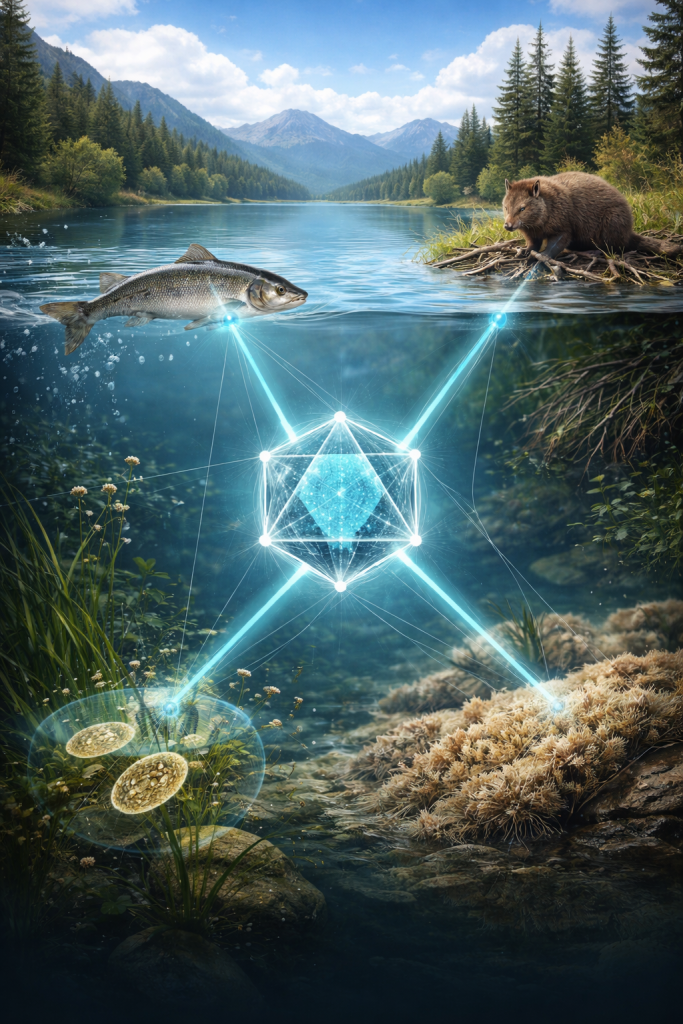
Imagen representativa ✨✨representative imagen created with chatGPT